
Types of Humidification Systems
Humidity control systems fall into two primary categories: steam humidification and evaporative humidification. Both add moisture to the air, but they do so in very different ways. Understanding the strengths and limitations of each technology can help engineers, contractors, and facility owners select the best solution for their application.
DriSteem offers both steam and evaporative humidification technologies, allowing customers to choose the approach that best meets their performance, energy, water, and maintenance requirements.
What Are the Main Types of Humidification Systems?
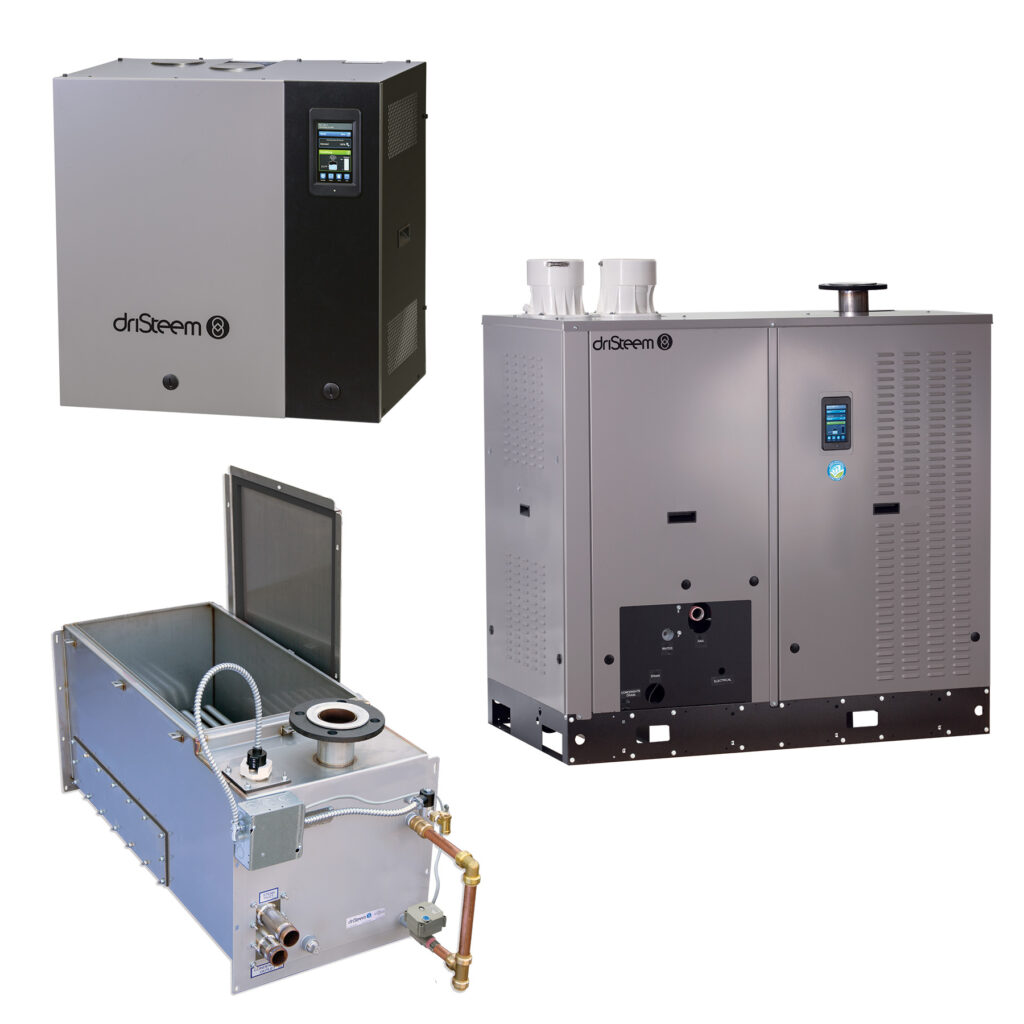
Steam Humidifiers (Isothermal)
Steam humidifiers boil water, adding water vapor directly into the airstream.
Because the water is converted to steam before entering the air, these systems are often called isothermal humidifiers.
DriSteem’s steam humidifier portfolio includes electric, gas-fired, electrode, steam-to-steam, and clean steam technologies.
Evaporative Humidifiers (Adiabatic)
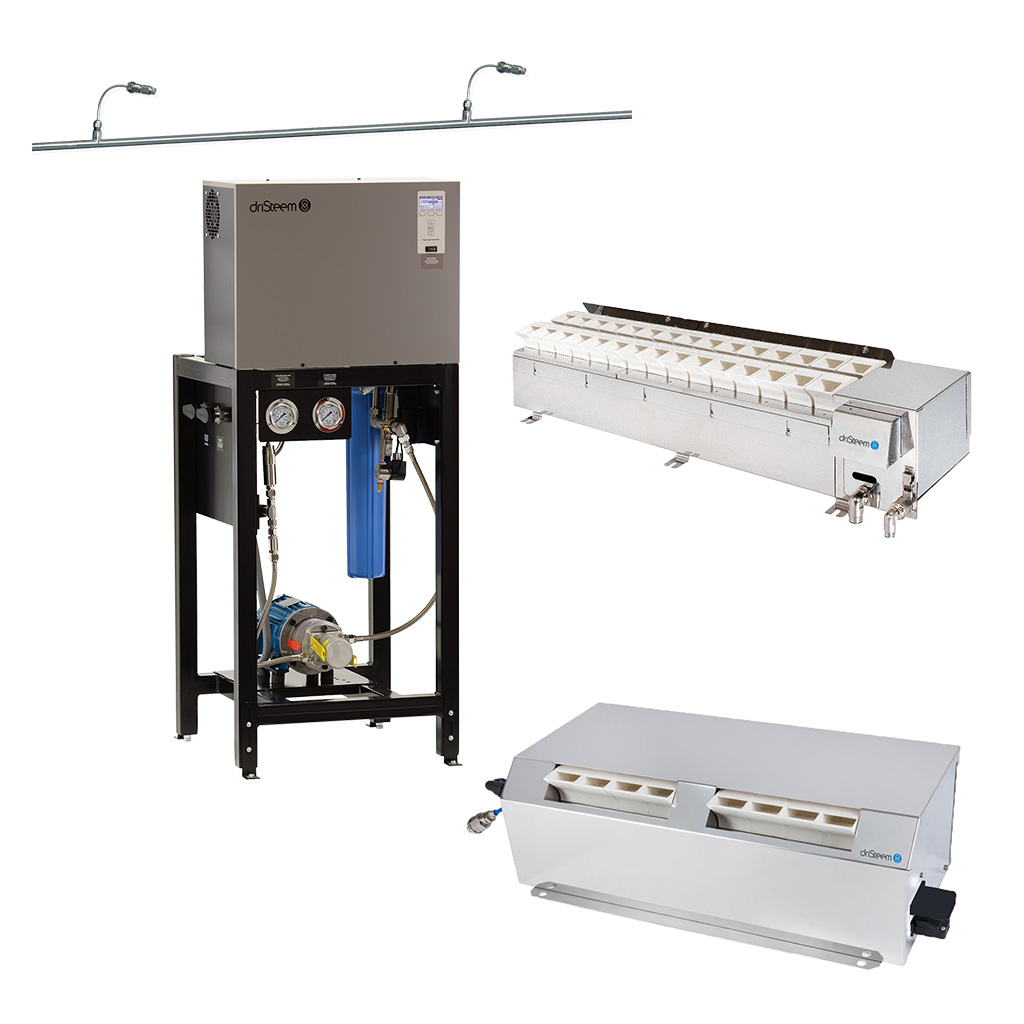
Evaporative, or adiabatic, humidifiers disperse water droplets into the air, where they evaporate naturally.
This process uses heat already present in the air rather than generating steam, making evaporative systems highly energy efficient.
High-pressure and ultrasonic humidifiers are common evaporative technologies and are available from DriSteem.
How Does Steam Humidification Work?
Steam humidifiers heat water until it becomes steam. The steam is then dispersed into a duct or air handling unit and rapidly absorbed into the airstream. Because steam already exists as water vapor, steam systems provide highly accurate humidity control and predictable performance regardless of air temperature. Steam is commonly used in applications with strict humidity requirements, including healthcare facilities, pharmaceutical manufacturing, laboratories, museums, and electronics production.
Advantages of Steam Humidification
- Precise humidity control
- Fast response to changing conditions
- Suitable for high-purity applications
- Effective in cold air streams
- Can maintain very tight humidity tolerances
Limitations of Steam Humidification
- Higher energy consumption because water must be boiled
- Higher operating costs in many applications
- May require fuel or significant electrical infrastructure
- Less opportunity for cooling benefits
How Does Evaporative Humidification Work?
Evaporative humidifiers introduce fine water droplets into the air. As the droplets evaporate, they add moisture while simultaneously cooling the air. This process requires far less energy than boiling water. In many facilities, evaporative systems can provide both humidification and free cooling, reducing mechanical cooling loads. High-pressure systems are commonly used in data centers, manufacturing facilities, printing operations, and other applications where energy efficiency is a priority.
Advantages of Evaporative Humidification
- Very low energy consumption
- Lower operating costs
- Can reduce building cooling loads
- Supports sustainability and decarbonization goals
- Well suited for large humidification loads
Limitations of Evaporative Humidification
- Performance depends on available evaporation capacity in the air
- Requires water treatment and water quality management
- May need longer absorption distances in some applications
- Can be more sensitive to system design and airflow conditions
Which Humidification System Is More Energy Efficient?
For most applications, evaporative humidification uses significantly less energy than steam humidification because it does not boil water. Instead, it uses the natural evaporation process to add moisture to the air. Additionally, evaporative systems can often reduce cooling loads through the evaporative process. However, energy efficiency is only one factor in system selection. Some facilities require the precision, cleanliness, or response time that steam humidification provides.
Which Humidification System Is Best for Your Facility?
There is no universal answer. The best humidification technology depends on your application priorities.
Steam Humidification Is Often Preferred When:
- Precise humidity control is critical
- Cleanliness and hygiene are top priorities
- Humidity must be maintained year-round, regardless of air conditions
- Healthcare, pharmaceutical, laboratory, or museum requirements drive the design
Evaporative Humidification Is Often Preferred When:
- Energy efficiency is a primary goal
- Large humidification loads are required
- Free cooling can provide value
- Sustainability and operating cost reduction are priorities
- The building has suitable airflow and evaporation capacity
Frequently Asked Questions
- What is the difference between steam and evaporative humidification?
- Steam systems add water vapor by boiling water. Evaporative systems disperse water into the air, where it evaporates naturally.
- Is evaporative humidification more efficient than steam?
- In most applications, yes. Evaporative systems typically require much less energy because they do not generate steam.
- Does evaporative humidification cool the air?
- Yes. As water evaporates, it absorbs heat from the surrounding air, creating a cooling effect.
- Which humidification system is best for healthcare facilities?
- Both technologies are used in healthcare applications. Steam has traditionally been the preferred choice for critical environments, while modern adiabatic systems are increasingly being considered where permitted by applicable standards and project requirements.
- Can DriSteem provide both steam and evaporative humidification solutions?
- Yes. DriSteem offers a complete portfolio of steam humidifiers, evaporative humidifiers, water treatment systems, and controls to support a wide range of commercial and industrial applications.
Connect with a humidity control expert
Next Steps
Contact your local DriSteem representative to learn more about humidity control. Use the Find a Rep tool below to find your nearest representative.