
What Is a Good Indoor Humidity Range?
A good indoor humidity range depends on what you are trying to protect or achieve. There is no single “perfect” humidity level for all buildings, spaces, or applications.
Instead, humidity targets are set based on goals such as occupant comfort, indoor air quality, static control, material protection, or process requirements.
Key takeaway: The “right” humidity range varies by application, risk, and performance goals.
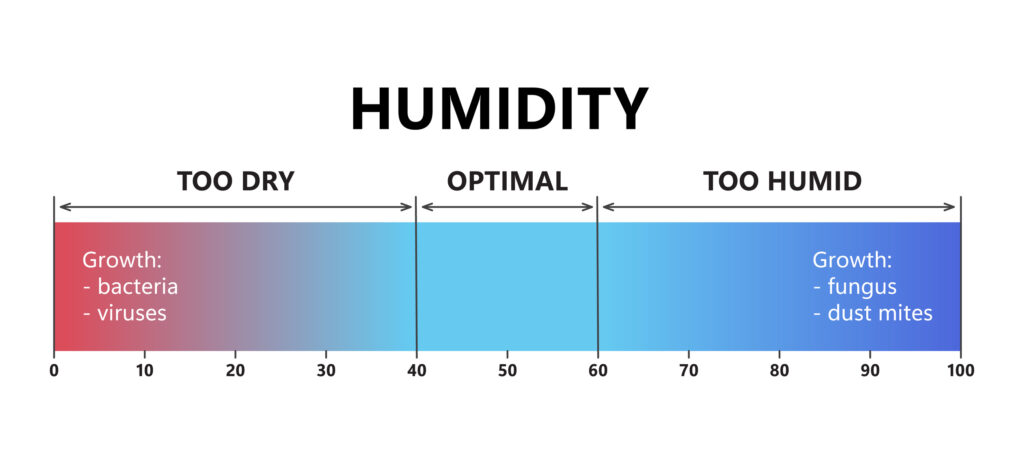
Commonly Recommended Indoor Humidity Ranges
In many occupied commercial and institutional spaces, indoor relative humidity is commonly maintained within a moderate range. Two ranges are often referenced:
- 40–60% RH
Used to support indoor air quality, comfort, and the reduction of biological growth risks - 30–60% RH
Used where static electricity control, material stability, or broader operating flexibility is required
Both ranges are valid, depending on conditions and priorities.
Key takeaway: Different humidity ranges are used for different objectives, not because guidance is inconsistent.
Why 40–60% RH Is Often Recommended for IAQ
The 40–60% RH range is frequently associated with indoor air quality and occupant well‑being. Within this range:
- Comfort complaints tend to decrease
- Dry air irritation is reduced
- Conditions that support mold growth are limited
- Biological contaminants are less likely to thrive
In many offices, schools, healthcare settings, and public spaces, this range effectively balances comfort and risk.
Key takeaway: 40–60% RH is commonly used when occupant comfort and IAQ are the primary concerns.
Why 30–60% RH Is Used for Static and Material Control
Some environments prioritize static reduction, material protection, or operational flexibility, especially where colder temperatures or process sensitivity are involved. In these cases:
- Humidity below ~30% RH increases static risk
- Humidity above ~60% RH increases condensation and corrosion risk
Maintaining 30–60% RH helps manage static electricity while allowing facilities to avoid condensation during cold weather or on cool surfaces.
Key takeaway: 30–60% RH is often used when static control and condensation risk must both be managed.
Why Humidity Targets Cannot Be One‑Size‑Fits‑All
Humidity targets must account for real‑world conditions, including:
- Building type and use
- Seasonal outdoor conditions
- Surface temperatures
- Ventilation rates
- Sensitivity of materials or processes
For example:
- A museum may prioritize narrow, stable humidity control
- An electronics space may focus on static reduction
- A hospital may follow code‑driven requirements
- A warehouse may accept a wider operating range
Key takeaway: Humidity targets must consider risk, not just averages.
The Role of Temperature and Condensation Risk
Humidity cannot be set without considering temperature. As humidity increases:
- Dew point rises
- Condensation risk increases on cool surfaces
This is why some buildings intentionally operate closer to the lower end of recommended ranges during cold weather, even when higher humidity might be acceptable in other seasons.
Key takeaway: A “safe” humidity level depends on surface temperatures as much as comfort goals.
Stability Matters More Than Precision
Frequent or wide humidity swings often cause more problems than operating slightly outside an ideal number. Stable humidity:
- Reduces material stress
- Improves comfort perception
- Protects equipment and finishes
- Simplifies system control
Well‑designed systems focus on maintaining consistent humidity within an appropriate range, rather than chasing a single exact percentage.
Key takeaway: Consistent humidity is more important than hitting a perfect number.
Related Topics
- Humidity Control Fundamentals
- What Is Relative Humidity (RH)?
- What Problems Does Low Humidity Cause?
- What Problems Does High Humidity Cause?
- What Is Dew Point and Why It Matters
Connect with a humidity control expert
Next Steps
Contact your local DriSteem representative to learn more about humidity control. Use the Find a Rep tool below to find your nearest representative.