
What Is Relative Humidity?
Relative humidity (RH) is a measure of how much moisture is in the air compared to how much moisture the air can hold at a given temperature.
It is expressed as a percentage. For example:
- 50% RH means the air is holding half of the moisture it could hold at that temperature
- 100% RH means the air is fully saturated and cannot hold additional moisture
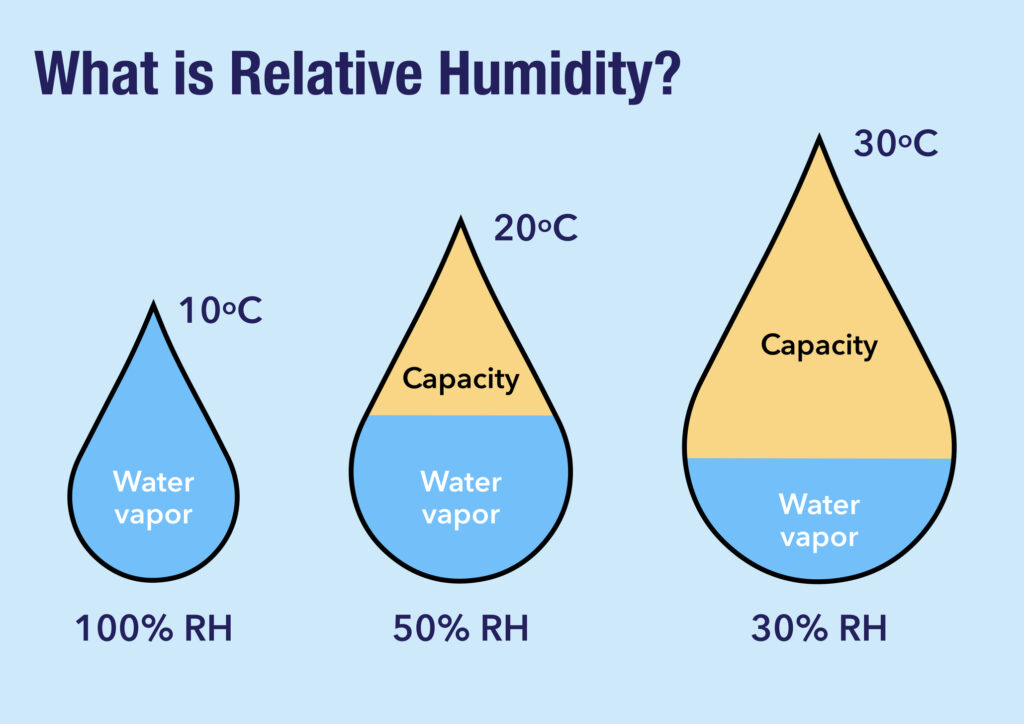
Relative humidity is the most common way humidity is measured and controlled in buildings because it directly affects comfort, condensation risk, materials, and processes.
Key takeaway: Relative humidity describes how “full” the air is with moisture, not the total amount of water in the air.
Humidity vs Relative Humidity
Humidity and relative humidity are related but not the same.
- Humidity refers to the actual amount of water vapor in the air
- Relative humidity compares the moisture to the maximum amount the air can hold at a specific temperature
This difference is important because the same air can contain the same amount of moisture, yet have very different relative humidity readings as temperature changes.
Key takeaway: Relative humidity depends on temperature, while total moisture content does not.
Why Relative Humidity Changes When Temperature Changes
Warm air can hold more moisture than cold air. When air is heated without adding moisture, the relative humidity decreases. When air is cooled without removing moisture, the relative humidity increases.
This is why:
- Indoor air often becomes very dry in winter when cold outdoor air is heated
- Condensation forms when warm, moist air cools and reaches saturation
No moisture needs to be added or removed for the relative humidity to change.
Key takeaway: Relative humidity changes with temperature, even when the amount of moisture in the air remains constant.
Why Relative Humidity Matters in Buildings
Relative humidity affects more than comfort. It influences how people feel, how materials behave, and how building systems perform.
When RH is too low:
- Static electricity increases
- Materials dry out and shrink
- Occupants may experience dry skin, eyes, and throat
When RH is too high:
- Condensation becomes more likely
- Mold and microbial growth risk increases
- Corrosion and material damage can occur
Because RH is closely tied to temperature and moisture, it is the primary control variable in HVAC and humidification systems.
Key takeaway: Relative humidity is a critical control point for comfort, indoor air quality, and building protection.
How Relative Humidity Is Measured
Relative humidity is measured using a hygrometer or humidity sensor. These sensors are commonly integrated into:
- Building management systems (BMS)
- HVAC controllers
- Stand‑alone humidistats
Accurate sensing and proper sensor placement are essential for effective humidity control.
Key takeaway: Reliable humidity control depends on accurate RH measurement and proper sensor placement.
Typical Relative Humidity Ranges
In many occupied buildings, relative humidity is commonly maintained within a moderate range, often between about 30% and 60% RH, depending on the application.
Some environments require tighter control due to:
- Product sensitivity
- Process stability
- Regulatory or preservation requirements
The correct RH target should always consider temperature, seasonal conditions, and condensation risk.
Key takeaway: There is no single “ideal” RH for all spaces, but stable, moderate ranges reduce risk and improve performance.
Related Topics
- Humidity Control Fundamentals
- What Is Dew Point and Why It Matters
- Psychrometric Chart Basics
- What Problems Does Low Humidity Cause?
- What Problems Does High Humidity Cause?
Connect with a humidity control expert
Next Steps
Contact your local DriSteem representative to learn more about humidity control. Use the Find a Rep tool below to find your nearest representative.