
How Temperature Changes Relative Humidity
Relative humidity changes with temperature, even if no moisture is added or removed from the air.
This relationship explains why indoor air often feels dry in winter, why condensation forms on cold surfaces, and why humidity control must consider both temperature and moisture together.
Understanding this relationship is fundamental to effective humidity control.
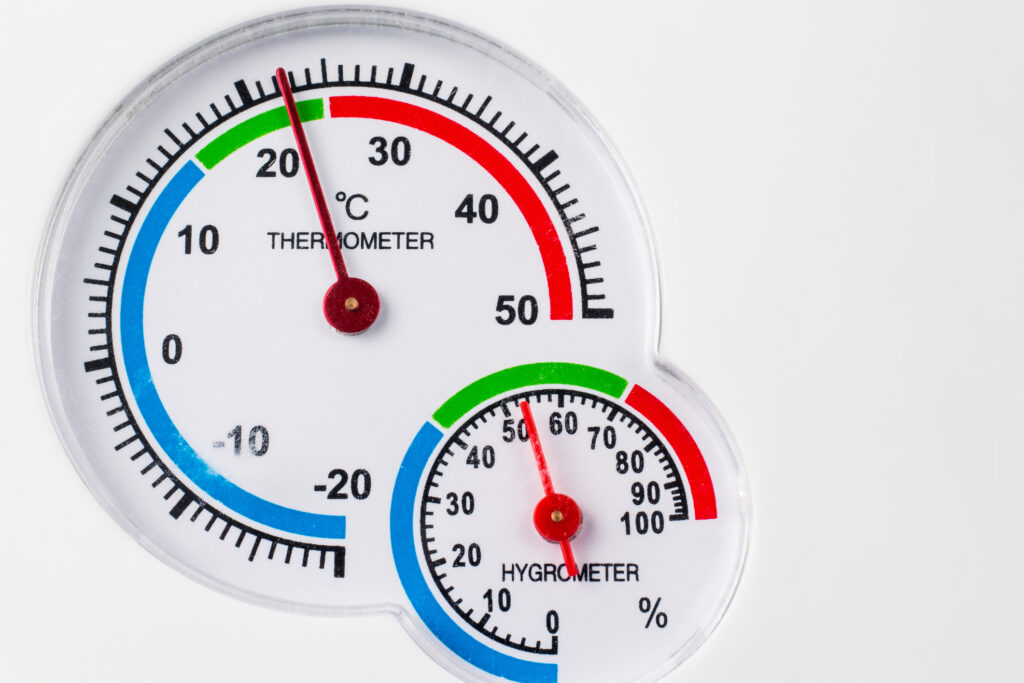
Key takeaway: Temperature directly affects relative humidity, independent of actual moisture content.
Why Temperature Matters for Relative Humidity
Air can hold different amounts of moisture depending on its temperature.
- Warm air can hold more moisture
- Cool air can hold less moisture
Relative humidity compares the amount of moisture in the air to how much the air can hold at that temperature. When temperature changes, the air’s moisture‑holding capacity changes, and relative humidity follows.
Key takeaway: Relative humidity reflects capacity, not just moisture.
What Happens When Air Is Heated
When air is heated without adding moisture, the relative humidity drops. This is common in cold climates:
- Outdoor air enters a building
- That air is heated by the HVAC system
- The moisture content stays the same
- Relative humidity decreases
This is why indoor air often becomes very dry during the winter heating season.
Key takeaway: Heating air lowers relative humidity unless moisture is added.
What Happens When Air Is Cooled
When air is cooled without removing moisture, the relative humidity rises. As air temperature drops:
- The air’s ability to hold moisture decreases
- Relative humidity increases
- If cooling continues, the air may reach saturation
If the temperature falls far enough, condensation begins to form.
Key takeaway: Cooling air raises relative humidity, increasing the risk of condensation.
Why This Causes Condensation Problems
Condensation occurs when a surface temperature falls below the dew point of the surrounding air. This often happens when:
- Warm, moist air contacts cold windows or walls
- Chilled ductwork or pipes are exposed to humid air
- Outdoor air with high moisture content enters a cooled space
Relative humidity alone does not predict condensation. Temperature and dew point must also be considered.
Key takeaway: Condensation risk depends on both temperature and moisture conditions.
A Simple Way to Think About It
Think of air like a container:
- Heating the air makes the container bigger
- Cooling the air makes the container smaller
If the container shrinks enough, its contents no longer fit, and moisture spills out as condensation.
Relative humidity tells you how full the container is, but temperature determines the container size.
Key takeaway: Temperature sets the limit for how much moisture air can hold.
Why This Relationship Matters for Humidity Control
Humidity control is not just about hitting a target humidity number. It requires managing:
- Temperature
- Moisture input
- Condensation risk
This is why humidification systems, controls, and setpoints must be selected based on real operating conditions, not assumptions. Ignoring the temperature‑humidity relationship often leads to:
- Over‑humidification
- Condensation complaints
- Mold or corrosion issues
Key takeaway: Successful humidity control accounts for how temperature changes relative humidity.
Related Topics
- Humidity Control Fundamentals
- What Is Relative Humidity (RH)?
- Humidity vs Relative Humidity: What’s the Difference?
- What Is Dew Point and Why It Matters
- What Humidity Level Is Too Low or Too High?
Connect with a humidity control expert
Next Steps
Contact your local DriSteem representative to learn more about humidity control. Use the Find a Rep tool below to find your nearest representative.